Deep-Learning-Based Evolutionary Operators
Evolutionary algorithms search by repeatedly selecting, recombining and mutating a population of candidate solutions. For decades, the operators that do this work have been blind: they make random changes and let selection sort out the good from the bad. Since 2024, our group has been replacing these blind operators with deep networks that learn, during the run itself, how to search.
Why learn the operators?
Classical genetic operators are domain-independent precisely because they ignore the domain. One-point crossover cuts the parents at a random position, uniform mutation changes random genes, and tournament selection always prefers the fittest of k random individuals. None of them knows which genes work well together, which edits tend to help, or how much selection pressure the population needs right now. Domain-specific operators can encode that knowledge, but someone has to design them anew for every problem.
Fitness evaluation is the second bottleneck. When computing an individual’s fitness means running a simulation, most of a run’s time goes into evaluating individuals that are discarded a generation later.
Learning to evolve
We treat an evolutionary run as a stream of training data. Every generation shows which parents produced good offspring, which edits improved an individual, and which selections paid off. Our operators are deep networks trained online, inside the run, mostly with policy-gradient reinforcement learning whose reward is the fitness of the offspring they produce. The result is an operator that adapts to the problem at hand while staying domain-independent: each one plugs into a standard genetic algorithm (GA) or genetic programming (GP) loop and replaces a single step.
Crossover: Deep Neural Crossover Back to top
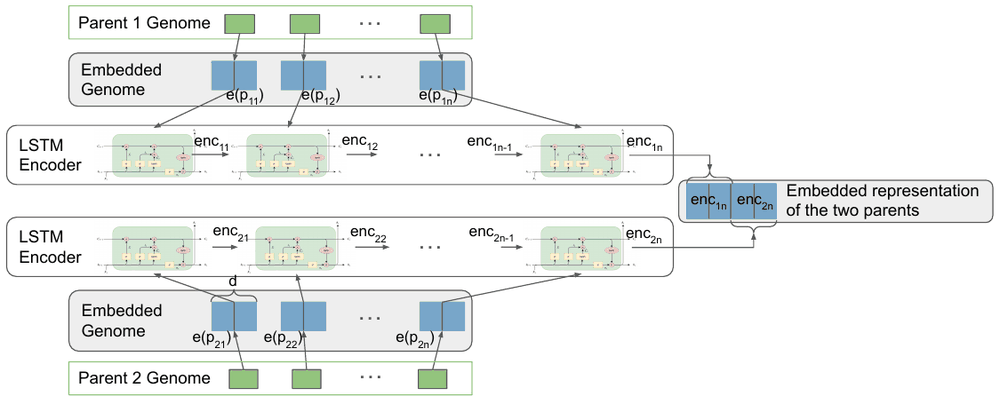
Deep Neural Crossover (DNC) is a multi-parent crossover operator for GAs. An encoder embeds each parent’s genes in a shared latent space, much as language models embed words, and an LSTM summarizes each parent. A decoder with a pointer network then builds the child one gene at a time, choosing which parent to copy from at each position based on the genes chosen so far. Trained with the child’s fitness as reward, DNC learns linear and non-linear correlations between genes that random crossover ignores, and it outperformed all baseline operators on graph coloring and bin packing. A transfer-learning variant trains on one problem instance and reuses the network on others from the same domain.
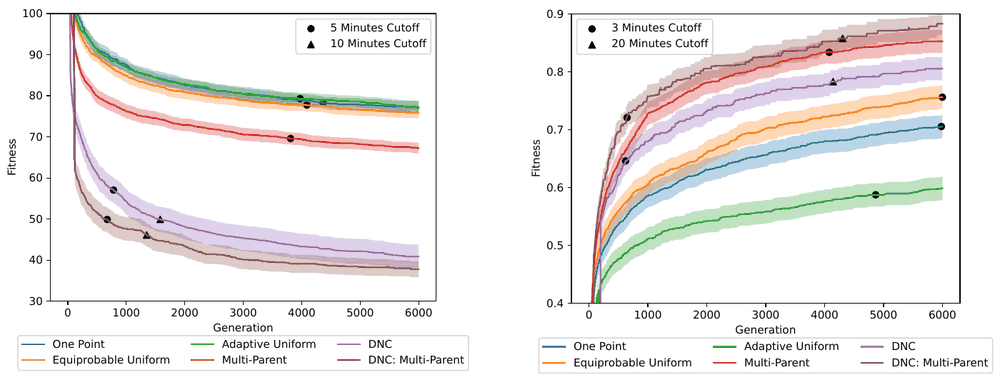
Learned operators cost energy as well as time. A follow-up study profiled DNC’s power consumption and introduced a fitness-based training schedule, which runs backpropagation only after a meaningful fitness improvement. The schedule cuts energy use considerably while keeping solution quality close to, and sometimes better than, the best configurations.
Papers
-
Energy-Efficient AI-Assisted Evolution: A Case Study on Minimizing the Power Consumption of Deep Neural Crossover
International Conference on Parallel Problem Solving from Nature (PPSN), vol. 16989, pp. 417–432, 2026
view online
[abstract]
Deep-learning-based genetic operators can substantially improve evolutionary search quality, but they also introduce significant computational and energy overhead, bringing the Red AI vs. Green AI tension into evolutionary computation. In this work, we study the energy footprint of Deep Neural Crossover, a reinforcement-learning-based multi-parent crossover operator, and evaluate parameter-level strategies to reduce its power consumption without sacrificing solution quality. We profile experiments with process-level energy measurements and analyze two optimization levers: training batch size and a new fitness-based scheduling threshold that triggers backpropagation only after meaningful fitness improvement. Experiments on benchmark Bin-Packing and Graph Coloring instances show that changing batch size alone has little effect on total energy, whereas the proposed scheduling strategy yields substantial savings. In particular, using larger scheduling thresholds considerably reduces energy consumption while keeping fitness close to the best-performing configurations and, in several cases, matching or improving it. These results provide a practical pathway for greener neuro-evolutionary algorithms through adaptive training schedules.
[bib]
@inproceedings{Foyershtein2026EnergyEfficientDNC, author = {Foyershtein, Amit O. and Merelo, Juan J. and Elyasaf, Achiya}, booktitle = {International Conference on Parallel Problem Solving from Nature (PPSN)}, title = {Energy-Efficient AI-Assisted Evolution: A Case Study on Minimizing the Power Consumption of Deep Neural Crossover}, year = {2026}, volume = {16989}, pages = {417--432}, publisher = {Springer Nature Switzerland}, url = {https://link.springer.com/chapter/10.1007/978-3-032-36217-9_26}, doi = {10.1007/978-3-032-36217-9_26}, groups = {Artificial Intelligence, Evolutionary Computation, Machine Learning} } -
Deep learning-based operators for evolutionary algorithms
Genetic Programming Theory and Practice XXI, 2025
view online
[abstract]
We present two novel domain-independent genetic operators that harness the capabilities of deep learning: a crossover operator for genetic algorithms and a mutation operator for genetic programming. Deep Neural Crossover leverages the capabilities of deep reinforcement learning and an encoder-decoder architecture to select offspring genes. BERT mutation masks multiple gp-tree nodes and then tries to replace these masks with nodes that will most likely improve the individual’s fitness. We show the efficacy of both operators through experimentation.
[bib]
@incollection{ShemTov2024DLOperators, author = {Shem-Tov, Eliad and Sipper, Moshe and Elyasaf, Achiya}, booktitle = {Genetic Programming Theory and Practice XXI}, title = {Deep learning-based operators for evolutionary algorithms}, year = {2025}, address = {University of Michigan, USA}, editor = {Banzhaf, Wolfgang and Hu, Ting and Lalejini, Alexander and Winkler, Stephan}, month = jun, series = {Genetic and Evolutionary Computation}, doi = {10.1007/978-981-96-0077-9_3}, groups = {Artificial Intelligence, Evolutionary Computation, Machine Learning} } -
Deep Neural Crossover: A Multi-Parent Operator That Leverages Gene Correlations
Proceedings of the Genetic and Evolutionary Computation Conference, pp. 1045–1053, 2024
view online
[abstract]
We present a novel multi-parent crossover operator in genetic algorithms (GAs) called "Deep Neural Crossover" (DNC). Unlike conventional GA crossover operators that rely on a random selection of parental genes, DNC leverages the capabilities of deep reinforcement learning (DRL) and an encoder-decoder architecture to select the genes. Specifically, we use DRL to learn a policy for selecting promising genes. The policy is stochastic, to maintain the stochastic nature of GAs, representing a distribution for selecting genes with a higher probability of improving fitness. Our architecture features a recurrent neural network (RNN) to encode the parental genomes into latent memory states, and a decoder RNN that utilizes an attention-based pointing mechanism to generate a distribution over the next selected gene in the offspring. The operator’s architecture is designed to find linear and nonlinear correlations between genes and translate them to gene selection. To reduce computational cost, we present a transfer-learning approach, wherein the architecture is initially trained on a single problem within a specific domain and then applied to solving other problems of the same domain. We compare DNC to known operators from the literature over two benchmark domains, outperforming all baselines.
[bib]
@inprocceedings{ShemTov2024DNC,
  address = {New York, NY, USA},
  author = {Shem-Tov, Eliad and Elyasaf, Achiya},
  booktitle = {Proceedings of the Genetic and Evolutionary Computation Conference},
  doi = {10.1145/3638529.3654020},
  groups = {Artificial Intelligence, Evolutionary Computation, Machine Learning},
  isbn = {9798400704949},
  keywords = {genetic algorithm, recombination operator, reinforcement learning, combinatorial optimization, surrogate model},
  location = {Melbourne, VIC, Australia},
  numpages = {9},
  pages = {1045--1053},
  publisher = {Association for Computing Machinery},
  series = {GECCO '24},
  title = {Deep Neural Crossover: A Multi-Parent Operator That Leverages Gene Correlations},
  url = {https://doi.org/10.1145/3638529.3654020},
  year = {2024}
}
Mutation: BERT Mutation Back to top
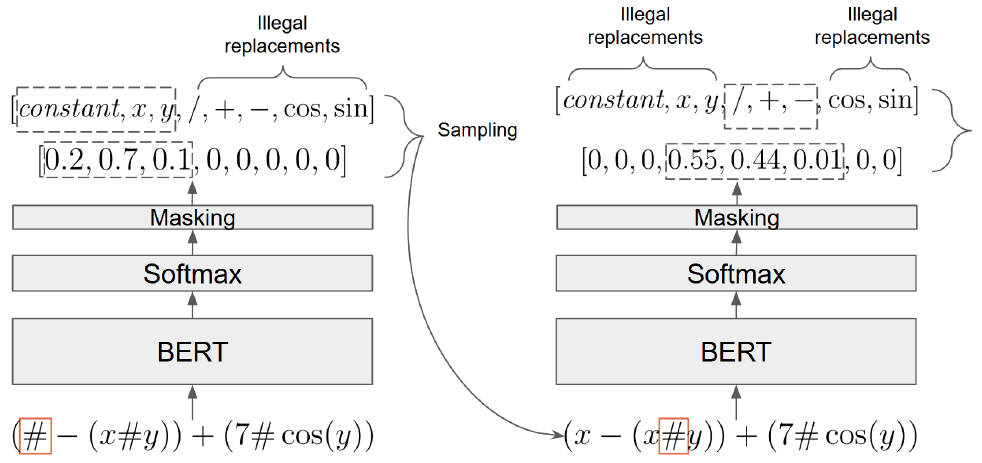
BERT Mutation borrows masked language modeling from natural-language processing. For GP, an individual’s tree is written out as a sequence of tokens, some nodes are masked, and a BERT transformer predicts replacements for the masks one at a time. Sampling is restricted to valid choices, so a terminal is replaced only by a terminal and a function only by a function of the same arity. The model is trained with reinforcement learning to prefer replacements that raise fitness. Across symbolic regression, classification and the Artificial Ant problem, it outperformed conventional and state-of-the-art mutation operators in both convergence speed and solution quality.
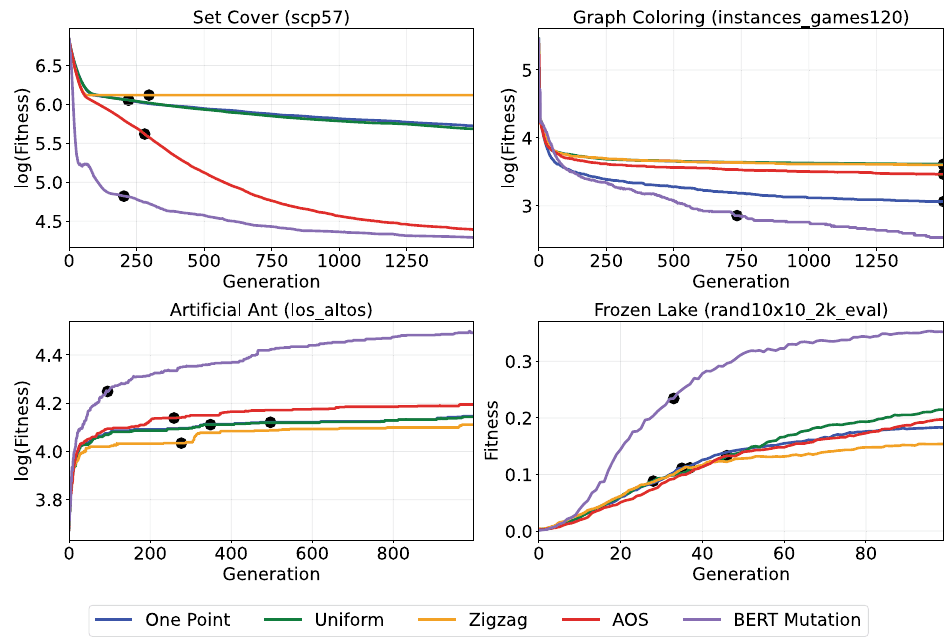
Extending the idea to GAs is harder: a fixed-length integer or binary vector has no explicit structure for the model to read, a problem we call semantic opacity. BERT Mutation for GAs overcomes it with a data-augmentation strategy that builds pseudo-training examples leading toward the population’s elite. On Frozen Lake, Artificial Ant, Graph Coloring and Set Cover, it beat One-Point, Uniform, Zigzag and adaptive operator selection, reaching better average fitness in about half the wall-clock time and fewer than half the generations, while preserving population diversity.
Papers
-
BERT Mutation for Genetic Algorithms: A Deep Transformer Operator
International Conference on Parallel Problem Solving from Nature (PPSN), vol. 16989, pp. 249–265, 2026
view online
[abstract]
Traditional genetic algorithm mutation strategies typically apply stochastic gene modifications without considering broader genomic context or learning from historical evolutionary data. To address this, we introduce BERT Mutation for Genetic Algorithms (GAs), a novel, domain-independent contextual mutation operator that adapts the Transformer architecture to fixed-length genetic representations. While deep learning-based operators have shown success in Genetic Programming, extending them to GAs is challenged by “semantic opacity”—the lack of explicit structural definitions in linear integer or binary vectors. To overcome this, we propose a novel data augmentation strategy that generates pseudo-training examples derived from the population’s elite. This strategy enriches the training signal by constructing augmented trajectories toward high-fitness solutions, stabilizing the reinforcement learning process. We evaluate the operator across four diverse domains: Frozen Lake, Artificial Ant, Graph Coloring, and Unweighted Set Cover. Our results demonstrate that BERT Mutation consistently outperforms traditional stochastic operators (One-Point, Uniform, and Zigzag) and an adaptive operator (AOS) in both convergence speed and final solution quality. Notably, BERT Mutation achieves superior average fitness in approximately half the wall-clock time and fewer than half the generations required by competing baselines. Furthermore, diversity analysis confirms that BERT Mutation preserves structured, meaningful population diversity, avoiding the premature convergence seen in simpler operators.
[bib]
@inproceedings{ShemTov2026BertMutationGA, author = {Shem-Tov, Eliad and Elyasaf, Achiya}, booktitle = {International Conference on Parallel Problem Solving from Nature (PPSN)}, title = {BERT Mutation for Genetic Algorithms: A Deep Transformer Operator}, year = {2026}, volume = {16989}, pages = {249--265}, publisher = {Springer Nature Switzerland}, url = {https://link.springer.com/chapter/10.1007/978-3-032-36217-9_16}, doi = {10.1007/978-3-032-36217-9_16}, groups = {Artificial Intelligence, Evolutionary Computation, Machine Learning} } -
BERT Mutation: Deep Transformer Model for Masked Uniform Mutation in Genetic Programming
Mathematics (2227-7390), vol. 13, no. 5, 2025
view online
[abstract]
We introduce BERT mutation, a novel, domain-independent mutation operator for Genetic Programming (GP) that leverages advanced Natural Language Processing (NLP) techniques to improve convergence, particularly using the Masked Language Modeling approach. By combining the capabilities of deep reinforcement learning and the BERT transformer architecture, BERT mutation intelligently suggests node replacements within GP trees to enhance their fitness. Unlike traditional stochastic mutation methods, BERT mutation adapts dynamically by using historical fitness data to optimize mutation decisions, resulting in more effective evolutionary improvements. Through comprehensive evaluations across three benchmark domains, we demonstrate that BERT mutation significantly outperforms conventional and state-of-the-art mutation operators in terms of convergence speed and solution quality. This work represents a pivotal step toward integrating state-of-the-art deep learning into evolutionary algorithms, pushing the boundaries of adaptive optimization in GP.
[bib]
@article{shem2025bert, author = {Shem-Tov, Eliad and Sipper, Moshe and Elyasaf, Achiya}, journal = {Mathematics (2227-7390)}, title = {BERT Mutation: Deep Transformer Model for Masked Uniform Mutation in Genetic Programming}, year = {2025}, number = {5}, volume = {13}, doi = {10.3390/math13050779}, groups = {Artificial Intelligence, Evolutionary Computation, Machine Learning} } -
Deep learning-based operators for evolutionary algorithms
Genetic Programming Theory and Practice XXI, 2025
view online
[abstract]
We present two novel domain-independent genetic operators that harness the capabilities of deep learning: a crossover operator for genetic algorithms and a mutation operator for genetic programming. Deep Neural Crossover leverages the capabilities of deep reinforcement learning and an encoder-decoder architecture to select offspring genes. BERT mutation masks multiple gp-tree nodes and then tries to replace these masks with nodes that will most likely improve the individual’s fitness. We show the efficacy of both operators through experimentation.
[bib]
@incollection{ShemTov2024DLOperators,
  author = {Shem-Tov, Eliad and Sipper, Moshe and Elyasaf, Achiya},
  booktitle = {Genetic Programming Theory and Practice XXI},
  title = {Deep learning-based operators for evolutionary algorithms},
  year = {2025},
  address = {University of Michigan, USA},
  editor = {Banzhaf, Wolfgang and Hu, Ting and Lalejini, Alexander and Winkler, Stephan},
  month = jun,
  series = {Genetic and Evolutionary Computation},
  doi = {10.1007/978-981-96-0077-9_3},
  groups = {Artificial Intelligence, Evolutionary Computation, Machine Learning}
}
Selection: Deep Tournament Selection Back to top
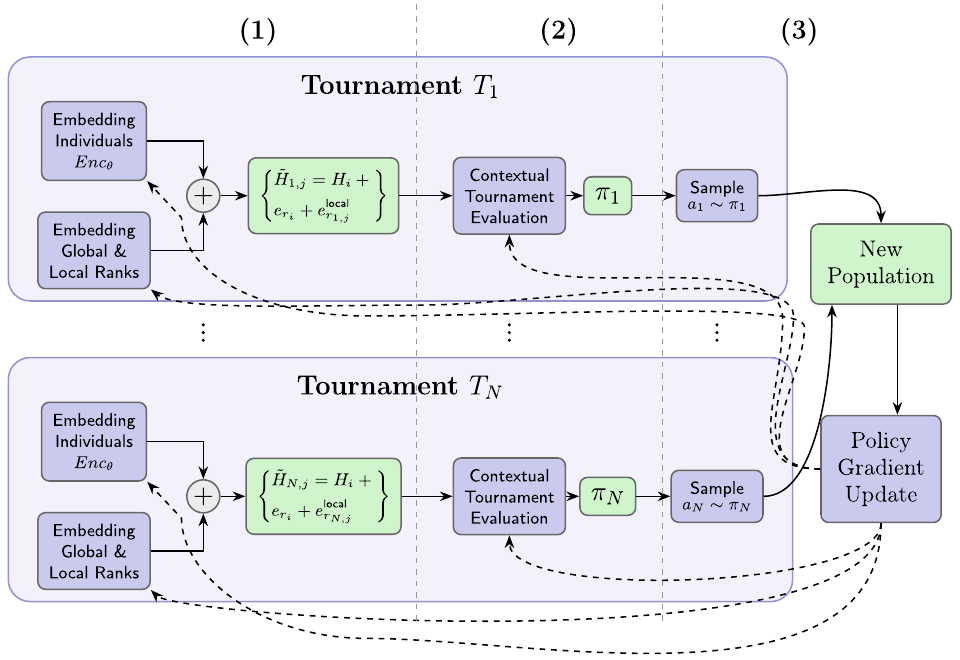
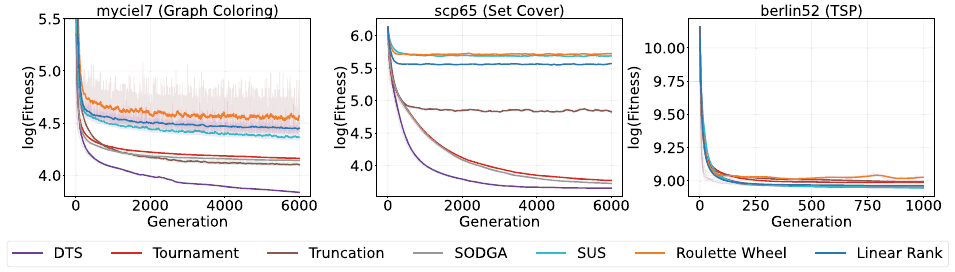
Selection decides how strongly the search exploits good solutions versus exploring new ones, yet classical schemes apply the same rule throughout the run. Deep Tournament Selection (DTS) reformulates tournament selection for GAs as a Markov decision process. A Transformer encoder with global and local rank-based positional encodings scores the candidates in each tournament, and a self-attention pointer picks the winner. The policy is trained fully online, needs no extra fitness evaluations, and adjusts its selection pressure as the population evolves. On Graph Coloring, Set Cover and the Traveling Salesman Problem, DTS converged faster and found better solutions than classical and dynamic selection baselines, with negligible overhead and no loss of diversity.
Papers
-
Deep Tournament Selection for Genetic Algorithms
International Conference on Parallel Problem Solving from Nature (PPSN), vol. 16987, pp. 522–538, 2026
view online
[abstract]
In Genetic Algorithms (GAs), the selection operator plays a critical role in balancing exploration and exploitation. However, classical and adaptive selection mechanisms largely rely on static rules or handcrafted heuristics that fail to adapt to the real-time dynamics of the evolving population. In this work, we introduce Deep Tournament Selection (DTS), a novel domain-independent selection operator that reformulates tournament selection as a Markov Decision Process optimized via reinforcement learning. DTS evaluates candidate solutions in a tournament using a Transformer encoder augmented with global and local rank-based positional encodings, along with a self-attention pointer mechanism. This architecture allows the selection policy to jointly capture global fitness relationships and local competitive context. The policy is trained fully online using policy-gradient reinforcement learning without requiring additional fitness evaluations, enabling the operator to dynamically adjust its selection pressure. We evaluate DTS on three canonical combinatorial optimization domains: Graph Coloring, Set Cover, and the Traveling Salesman Problem. Empirical results demonstrate that DTS achieves faster convergence, improved solution quality, and robust performance across problem instances compared to classical and dynamic selection baselines, while introducing negligible computational overhead and preserving population diversity.
[bib]
@inproceedings{ShemTov2026DeepTournamentSelection,
  author = {Shem-Tov, Eliad and Edri, Ron and Elyasaf, Achiya},
  booktitle = {International Conference on Parallel Problem Solving from Nature (PPSN)},
  title = {Deep Tournament Selection for Genetic Algorithms},
  year = {2026},
  volume = {16987},
  pages = {522--538},
  publisher = {Springer Nature Switzerland},
  url = {https://link.springer.com/chapter/10.1007/978-3-032-36226-1_32},
  doi = {10.1007/978-3-032-36226-1_32},
  groups = {Artificial Intelligence, Evolutionary Computation, Machine Learning}
}
Evaluation: fitness approximation Back to top
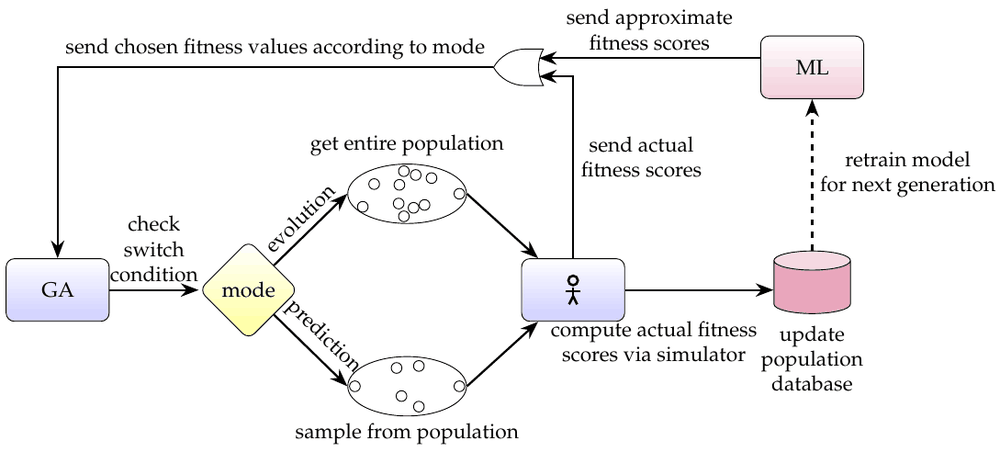
When fitness comes from a costly simulator, the cheapest evaluation is the one you never run. Our fitness-approximation method trains a machine-learning model on every individual a GA has evaluated so far and lets the GA switch dynamically between two modes. In evolution mode, every individual is simulated. In prediction mode, only a sample of the population is simulated, the rest receive the model’s prediction, and the model is retrained before the next generation. Evaluated on agents evolved in Gymnasium game simulators, the approach cut runtimes significantly while reaching fitness identical to, or slightly below, a fully simulated GA.
Papers
-
Fitness Approximation Through Machine Learning with Dynamic Adaptation to the Evolutionary State
Information, vol. 15, no. 12, pp. 744, 2024
view online
[abstract]
We present a novel approach to performing fitness approximation in genetic algorithms (GAs) using machine learning (ML) models, focusing on dynamic adaptation to the evolutionary state. We compare different methods for (1) switching between actual and approximate fitness, (2) sampling the population, and (3) weighting the samples. Experimental findings demonstrate significant improvement in evolutionary runtimes, with fitness scores that are either identical or slightly lower than those of the fully run GA—depending on the ratio of approximate-to-actual-fitness computation. Although we focus on evolutionary agents in Gymnasium (game) simulators—where fitness computation is costly—our approach is generic and can be easily applied to many different domains.
[bib]
@article{Tzruia2023FitnessApproximationMachine,
  author = {Tzruia, Itai and Halperin, Tomer and Sipper, Moshe and Elyasaf, Achiya},
  journal = {Information},
  title = {{Fitness Approximation Through Machine Learning with Dynamic Adaptation to the Evolutionary State}},
  year = {2024},
  issn = {2078-2489},
  number = {12},
  pages = {744},
  volume = {15},
  doi = {10.3390/info15120744},
  groups = {Artificial Intelligence, Evolutionary Computation, Machine Learning},
  publisher = {MDPI},
  url = {https://www.mdpi.com/2078-2489/15/12/744}
}